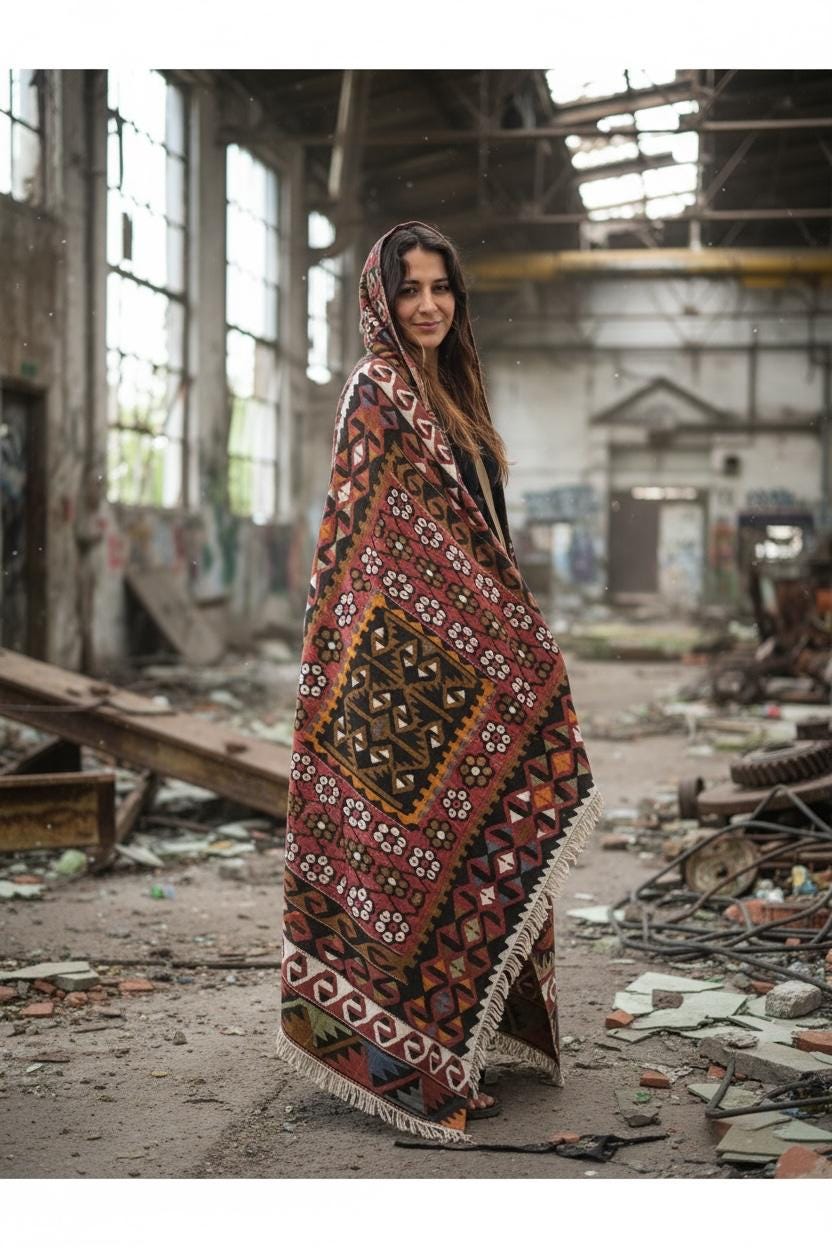
By Her Name is Rita · Handwoven textiles from Turkey
There's a common misconception about kilims: that they belong to winter. To candlelight and thick walls and the smell of wood smoke. Beautiful, yes — but seasonal.
We'd like to change that.
An Anatolian kilim is not a winter rug. It's a year-round textile, and in summer, it might just be one of the smartest things in your home.
What Is an Anatolian Kilim?
A kilim is a flat-woven textile — no pile, no thickness — made by tightly interlacing warp and weft threads. The tradition is thousands of years old, rooted in the villages and nomadic cultures of Anatolia, the vast plateau that forms the heart of modern Turkey.
Each kilim is hand-woven on a loom, often using wool, cotton, or a blend of natural fibres. The geometric patterns — diamonds, stars, stepped borders — are not decorative choices made by a designer. They are a visual language, passed down through generations, each motif carrying meaning: protection, fertility, the seasons, the land.
At Her Name is Rita, every kilim is sourced directly from Turkish artisans who have been weaving for decades.
Why Kilims Are Perfect for Summer
Natural Fibres That Breathe
Unlike synthetic rugs or thick-pile carpets, kilims are woven from natural materials — most commonly wool or cotton — that regulate temperature naturally. Wool, in particular, is a remarkable insulator in both directions: it keeps warmth in during winter and helps moderate heat during summer.
A flat-woven kilim on a stone, tile, or wooden floor doesn't trap heat the way a thick carpet does. It sits lightly, breathes, and keeps the space feeling cool and grounded.
They Cool the Eye, Too
Colour psychology matters in interior design, and the earthy palette of an Anatolian kilim — terracotta, sand, faded indigo, warm ivory — reads as cool and calm. Visually, a well-chosen kilim can make a room feel more composed, less airless, even on the hottest days.
This is not coincidence. These colours were developed in a climate not unlike the Mediterranean summer: hot days, dusty plains, bright light. They were made to be lived with in the heat.
Barefoot Comfort
In summer, we live closer to the floor. Bare feet on a kilim is one of life's small pleasures — the slight texture underfoot, the warmth of natural fibre, the sense of something real beneath you. A kilim invites that. A thick pile carpet, less so.
Where to Use a Kilim in Summer
On the terrace or covered outdoor space: A kilim under a table and chairs immediately transforms a terrace into a room. Choose one with faded, sun-bleached tones — they look even better outdoors.
In the bedroom: Replace the heavy winter rug with a lighter kilim runner beside the bed. Cool underfoot in the morning, beautiful to look at all day.
In the living room: Anchor a seating area without adding visual weight. A kilim grounds the furniture without making the space feel heavy or overdressed.
Under a dining table: Practical, beautiful, and easy to shake out. Kilims were made for daily use — don't treat them like museum pieces.
How to Care for a Kilim in Summer
Summer often means more dust, more foot traffic, open windows. The good news: kilims are remarkably easy to maintain.
- Shake them out regularly — fresh air and light movement keep the fibres clean
- Vacuum gently on the lowest setting, always in the direction of the weave
- If a kilim gets wet (spill, outdoor use), lay it flat in a shaded, ventilated space to dry
- Rotate occasionally to ensure even fading — especially important in rooms with direct sunlight
- Avoid prolonged exposure to harsh direct sun, which can bleach the dyes over time
The Craft Behind Every Kilim at Her Name is Rita
We don't source kilims from catalogues. Rifaa travels to Turkey, visits workshops, and selects each piece by hand. The kilims we carry are authentic — not reproductions, not machine-made approximations, but the real thing, with the small imperfections that prove it.
Some are vintage, carrying decades of history. Others are newly woven using the same traditional techniques. All of them are made to be used, not stored.
A Rug for Every Season
The best things in your home don't retire with the calendar. A well-chosen Anatolian kilim is with you in February and in August — grounding the space, cooling the eye, and reminding you that the most beautiful objects are almost always the most useful ones.
Find your kilim. Shop the kilim collection →
Her Name is Rita is an independent brand born in Barcelona, curating handmade objects and clothing from the Mediterranean and beyond.